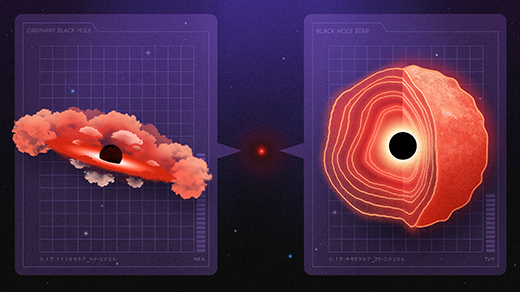
Black Holes or Black Hole Stars? Astronomers Spar Over Webb Telescope’s ‘Little Red Dots.’
Astronomers built the James Webb Space Telescope to pick up faint light from the first billion years after the Big Bang, a chaotic era when vast swaths of hydrogen and helium gas gathered into the chains of galaxies we see today. Even in the telescope’s first images, astronomers could see a whole zoo of mysterious smears of light. One batch of objects proved especially difficult to interpret. Source
Astronomers built the James Webb Space Telescope to pick up faint light from the first billion years after the Big Bang, a chaotic era when vast swaths of hydrogen and helium gas gathered into the chains of galaxies we see today. Even in the telescope’s first images, astronomers could see a whole zoo of mysterious smears of light. One batch of objects proved especially difficult to interpret.
Source
One batch of objects proved especially difficult to interpret. They glowed blindingly bright, emitting red light with long wavelengths and shining as brilliantly as a whole galaxy. They were tiny, spanning just a pixel. And they were everywhere. A couple appear in almost every image Webb takes. In 2023, researchers started calling them “ little red dots .” Astronomers have repeatedly pointed Webb toward the little red dots, wringing precious new information from these pixels of light.
Initially, researchers thought the dots looked kind of like galaxies. Later, they concluded that little red dots look more like the supermassive black holes that sit at the heart of most galaxies. These monstrous masses are themselves dark, but their formidable gravity violently vacuums up gas and other nearby matter, generating rings of hot, swirling detritus that completely outshine the stars around them.
Then, in the spring of 2025, two teams of astronomers simultaneously announced observations of a pair of little red dots that were unlike all the rest. In fact, they were unlike any object ever seen.
“In all the millions of [observations] we’ve taken with ground-based telescopes,” said Anna de Graaff , a researcher at the Max Planck Institute for Astronomy in Heidelberg, Germany, and head of one group, “there’s nothing that looks like these sources.”
The two teams of astronomers propose that they are looking at a new astronomical object: a topsy-turvy lump of hydrogen that shines with the light of billions of suns while hiding a black hole deep in its core. They call it a black hole star.