How Physicists Track and Trap the Elusive Neutrino
Seventy years ago, the physicists Clyde Cowan and Frederick Reines took a custom-built 10-ton detector, surrounded it with thick lead walls and wet sandbags, and placed it near a powerful nuclear reactor at the Savannah River Plant in South Carolina. They called the experiment “Project Poltergeist,” designed as it was to catch a ghost. More than a quarter of a century before… Source
Seventy years ago, the physicists Clyde Cowan and Frederick Reines took a custom-built 10-ton detector, surrounded it with thick lead walls and wet sandbags, and placed it near a powerful nuclear reactor at the Savannah River Plant in South Carolina. They called the experiment “Project Poltergeist,” designed as it was to catch a ghost. More than a quarter of a century before…
Source
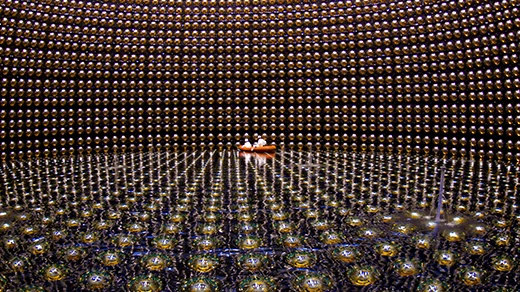
The Super-Kamiokande neutrino detector was rebuilt following a catastrophic chain-reaction implosion of some 6,600 of the photomultiplier tubes lining its walls. Here the observatory is being refilled with ultrapure water in 2006.
Kamioka Observatory, ICRR, The University of Tokyo
More than a quarter of a century before, physicists had been puzzling over why energy appeared to be lost during a radioactive process called beta decay. Something was missing, and there was no known physics to explain it. Then in 1930, the Austrian physicist Wolfgang Pauli proposed a radical solution: A virtually undetectable particle was silently carrying the missing energy away. “I have done a terrible thing,” Pauli told a friend. “I have postulated a particle that cannot be detected.” It would come to be known as the neutrino. Having almost no mass and no charge, these particles can pass through Earth and everything on it, including our bodies, virtually unimpeded.
The massive device that Cowan and Reines deployed in early 1956 was meant to find what Pauli thought was impossible. That June, the pair of physicists from the Los Alamos National Laboratory sent Pauli a telegram : “We are happy to inform you that we have definitely detected neutrinos.”
Attention then shifted to a broader question. If nuclear reactions produce neutrinos, could we use them to peer at the nuclear fireworks inside stars, including the sun? This presented a huge challenge: How can you possibly catch particles shooting from distant stars if these particles can pass through almost anything undetected? The suspicion was that detecting a particle that rarely collides with matter requires a vast amount of matter for it to collide with. Moreover, the matter would have to be shielded from the noise of other forms of radiation. So the answer scientists came up with was to build some of the biggest, deepest, and most exotic experimental traps in scientific history … and then wait.