Ctenophores Aren’t Just Beautiful. They’re Biological Wonders.
Around 700 million years ago, a group of organisms resembling little more than glowing, gelatinous blobs split off from the rest of the animals, forming possibly the earliest branching animal lineage. Nearly 200 species of ctenophores, commonly known as comb jellies (but unrelated to jellyfish), live today in environments ranging from the cold depths of the sea to warm coastal surface waters. Source
Around 700 million years ago, a group of organisms resembling little more than glowing, gelatinous blobs split off from the rest of the animals, forming possibly the earliest branching animal lineage. Nearly 200 species of ctenophores, commonly known as comb jellies (but unrelated to jellyfish), live today in environments ranging from the cold depths of the sea to warm coastal surface waters.
Source
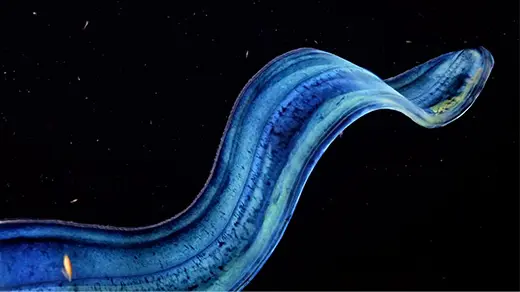
The ribbonlike Cestum veneris , or Venus’ girdle, is one of the largest ctenophore species and grows up to 1.5 meters in length.
Over the past decade, ctenophores have helped answer long-standing questions about fundamental biology, from how early nervous systems evolved to the origins of the mesmerizing phenomenon of bioluminescence .
Having access to closely related species across such variable environments “lets you ask questions about how certain things evolved,” such as adaptation to high pressure or light-sensing genes, said Steven Haddock , a marine biologist who studies ctenophores at the Monterey Bay Aquarium Research Institute.
“That’s one of the reasons why we work with ctenophores,” said Pawel Burkhardt , an evolutionary biologist at the University of Bergen who studies the origins and evolution of neurons and nervous systems. “They’re very exciting to work with, and they’re also extremely beautiful organisms.”