A New Framework for How the Brain Compresses Our Noisy World
Every moment of our lives, our bodies are awash in sensory signals. Photons hit our retinas. Waves of compressed air collide with our eardrums. Volatile molecules bind to receptors in our nostrils, and chemicals slather our taste buds. Pressure and heat activate nerve endings in our skin. We are able to navigate this torrent because the brain does an enormous amount of data compression. Source
Every moment of our lives, our bodies are awash in sensory signals. Photons hit our retinas. Waves of compressed air collide with our eardrums. Volatile molecules bind to receptors in our nostrils, and chemicals slather our taste buds. Pressure and heat activate nerve endings in our skin. We are able to navigate this torrent because the brain does an enormous amount of data compression.
Source
In neuroscience’s traditional view, categorization happens at the very end of sensory processing. The brain passively receives sensory details, then decodes their features and matches them to stored templates in memory, like a clerk shuffling through a neural filing cabinet. But this approach to categorization struggles to account for the extraordinary flexibility in the way we assign labels to features of the world. On a clear day on an open street, a sudden rhythmic patter is a pigeon taking flight, yet when we’re walking down a dimly lit alley at night, the same sound is the shuffle of a stranger’s footsteps. How can the brain categorize similar sets of sensory signals in radically different ways for different situations?
Two of the world’s leading neuroscientists have brought an updated understanding of brain function and structure to this question. In the pages of Nature Reviews Neuroscience , Lisa Feldman Barrett , who studies the psychology and neuroscience of emotion at Northeastern University, and Earl Miller , who studies how the brain carries out goal-directed behavior at the Massachusetts Institute of Technology, collaborated on a new view of categorization. They describe how the brain constantly reconstructs its categories moment to moment based not only on senses and memory, but on the body’s immediate physiological needs.
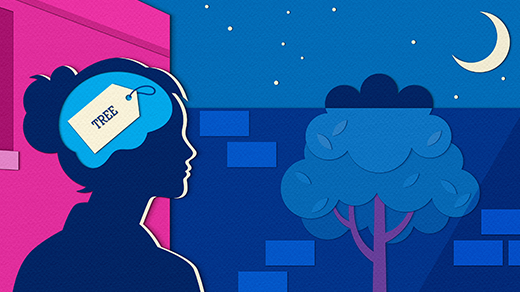
At the heart of their framework is a counterintuitive insight. While we may have the impression that our categories reflect an objective reality, the researchers argue that the brain projects categories onto the world in response to the body’s survival needs. Before we are even aware of our sensory impressions, the brain is already preparing the body to behave in ways that maintain the energetic resources that power our physiological systems. In this way, the brain’s predictions — rather than the cumulative effects of sensory information — ultimately shape and limit how we categorize objects and features of the world.
The duo’s framework is “a fresh perspective on categorization,” said Luiz Pessoa , a neuroscientist from the University of Maryland. Their idea of “the maintenance of the energetic constraints of life as fundamental to how we structure our categories,” he said, is “really important to pursue.”
Also new in Barrett and Miller’s framework is the hypothesis that categorization doesn’t happen in a particular area of the brain, but across the entire organ and beyond. To understand how organisms form categories, they argued, neuroscientists have to look all over the nervous system, from head to toe.