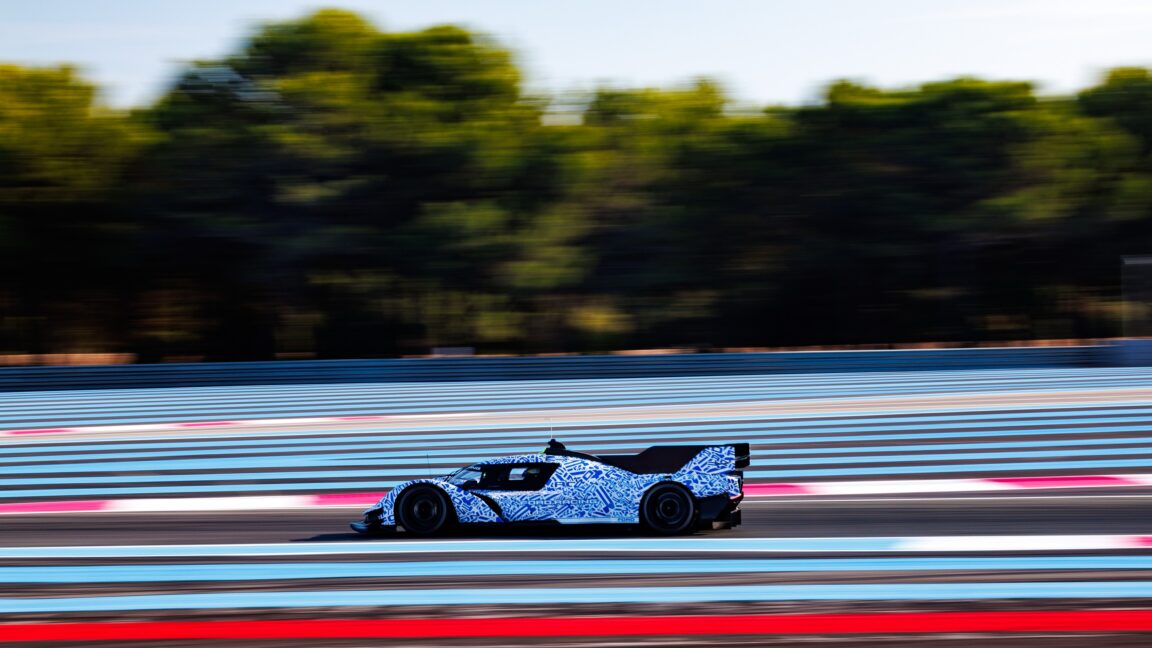
Ford hopes this Hypercar will be its next Le Mans winner
The car that Ford hopes will return it to overall victory at the 24 Hours of Le Mans made its unofficial debut this week. Ford sent us some pictures of the still-unnamed car conducting its first track test at the colorful Paul Ricard circuit in Provence, France, where drivers Matt Campbell and Logan Sargeant started the hard work of making the car both fast and reliable. Ford already has four overall wins at Le Mans, owning the top spot four years in a row. But the last of these wins came in 1969, when a privately entered—and at that point outdated—GT40 managed to beat Porsche's still-untamed 917 on the German car's debut. The company returned to top-level endurance racing in 1982 with the C100 during the early days of the Group C regulations, but the car was uncompetitive and unreliable, and the program soon ended. In 2016, 50 years on from its first win, a class win in the GTE-Pro category added some more silverware to the corporate display cabinet. Now, the soaring popularity of the Hypercar category in the World Endurance Championship and at Le Mans has tempted it back to the fastest class. Read full article Comments
The car that Ford hopes will return it to overall victory at the 24 Hours of Le Mans made its unofficial debut this week. Ford sent us some pictures of the still-unnamed car conducting its first track test at the colorful Paul Ricard circuit in Provence, France, where drivers Matt Campbell and Logan Sargeant started the hard work of making the car both fast and reliable.
The American automaker returns to the top category of endurance racing next year.
Sports car racing can often get a little complicated, which is why there are two ways to go about designing a car to enter the Hypercar category. One approach—referred to as LMH—involves designing and building the entire car yourself. The LMH rules allow you to mount the hybrid system’s electrical motor on the front axle, as Ferrari, Peugeot, and Toyota do, or leave it out entirely, as in the Aston Martin Valkyrie.
Everyone else uses the alternative LMDh approach, which requires the entrant to start with a carbon fiber chassis (or spine) from one of four approved race car manufacturers; in this case, Ford chose ORECA as the supplier. Each OEM also must use the same spec gearbox, electric hybrid motor, and hybrid battery, but they supply their own engine and software and design the bodywork. This is the approach used by Alpine, BMW, Cadillac, Genesis, and Porsche. McLaren and Ford will join them next year.