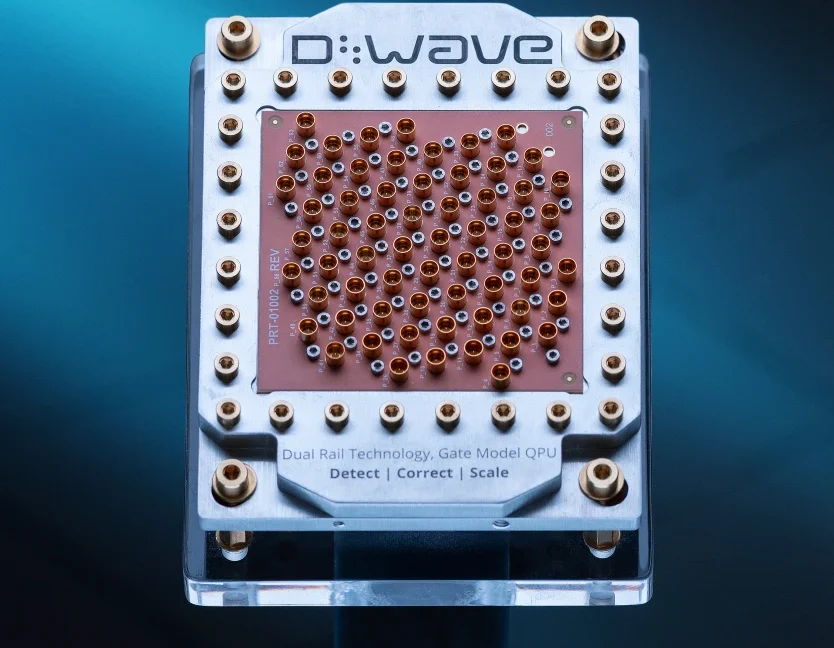
D-Wave shows off its new entry in quantum computing race
D-Wave is a bit of an oddity in the quantum computing space, having been founded back in the last century. And its initial offering wasn't a quantum computer like those being developed by IBM or Google. Instead, the company built what's now called a quantum annealer, a machine that isn't general-purpose but can solve a large class of optimization problems . While the hardware shares some similarities with the qubits used in gate-based quantum computers, it operates in a fundamentally different way. But a few years back, D-Wave started working on gate-based hardware, apparently choosing a somewhat unusual qubit technology called fluxonium . And this year, the company acquired a startup called Quantum Circuits that spun out of Yale University and has been developing what's called a dual-rail qubit (the same technology used by Amazon ), which promises to make most errors very easy to detect, simplifying error correction. On Wednesday, the company is publishing a paper in Nature that describes a key step in validating this dual-rail technology, showing that two of the qubits can be entangled without altering their best feature: Most are a single type that is easy to detect. Read full article Comments
Company noted for building quantum annealers now also making gate-based hardware.
The basic structure of a dual-rail qubit depends on making two linked resonators, which we’ll call left and right. If you place a single photon in the system and measure it, it will always be in either the left or right resonator. But it’s possible to place that single photon in a superposition of both left and right. Those are all the features you need to make a qubit.
The nice thing about the dual-rail setup is that the most common error is simply the photon escaping the hardware. (This is sometimes referred to as an “erasure qubit,” as the loss of the photon erases the information it contains.) The next most common error is flipping the phase of the qubit, with bit flips being a very distant third. Crucially, photon loss can be easily detected with the right hardware, without needing additional qubits required to run an error-correction code.