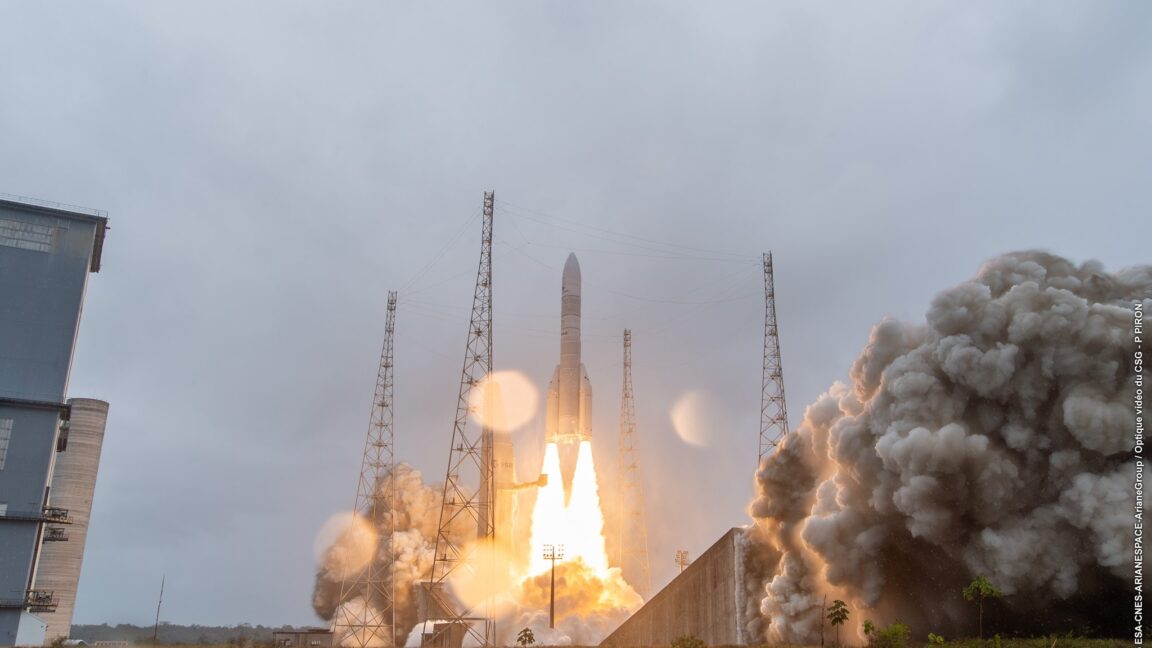
Europe cancels planned upgrades for Ariane 6 rocket
In the two years since it made a largely successful debut, Europe's Ariane 6 rocket has launched eight missions, all of which reached orbit safely. The large, expendable rocket has a capacity of more than 20 metric tons to low-Earth orbit. And to the credit of European rocket scientists and planners, the Ariane 6 has had a substantially smoother rollout than comparable vehicles in the United States—Blue Origin's New Glenn and United Launch Alliance's Vulcan rockets—both of which have had significant growing pains. However, even though the Ariane 6 rocket has had a successful debut, its future is clouded by high costs. Read full article Comments
In the two years since it made a largely successful debut, Europe's Ariane 6 rocket has launched eight missions, all of which reached orbit safely.
The large, expendable rocket has a capacity of more than 20 metric tons to low-Earth orbit. And to the credit of European rocket scientists and planners, the Ariane 6 has had a substantially smoother rollout than comparable vehicles in the United States—Blue Origin's New Glenn and United Launch Alliance's Vulcan rockets—both of which have had significant growing pains.
Arianespace hasn’t publicly disclosed the cost for an Ariane 6 launch.
On Thursday, European Spaceflight reported that “Block 3” upgrades for the Ariane 6 rocket have been shelved by the European Space Agency. A key element of the “Block 3” evolution of Ariane 6 was the lightweight ICARUS upper stage, which would have used carbon-composite structures.
The cancellation of this upgrade has implications for some of the European Space Agency’s science missions, including a probe to Saturn’s icy moon Enceladus.