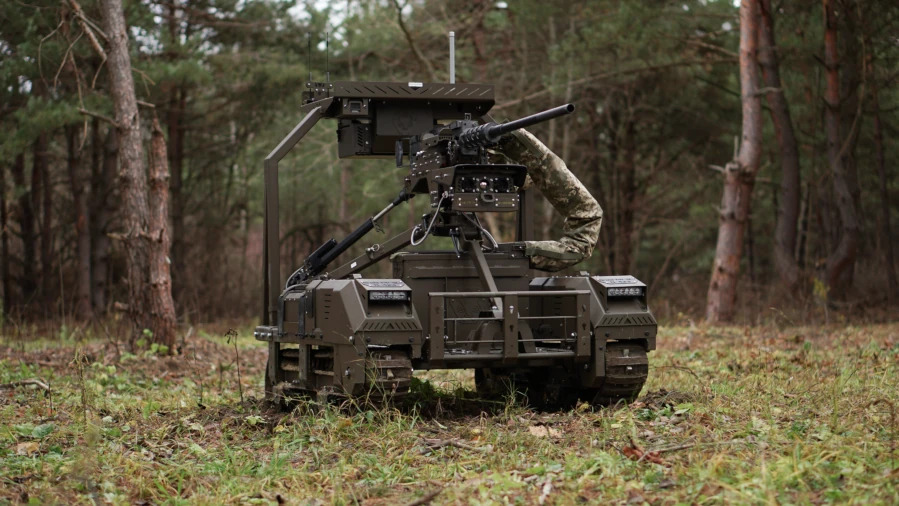
Ukraine’s military robot surge aims to offset drone risks to humans
Ukrainian ground robots and drones have demonstrated how to overcome a Russian military position by themselves while forcing the surrender of Russian soldiers, claimed Ukrainian President Volodymyr Zelenskyy.
Ukraine is replacing more soldiers with robots in the battlefield kill zone.
The claim by Zelenskyy has not been independently verified but was accompanied by a promotional video in which he described Ukraine’s military robots as having completed over 22,000 missions in the last three months. Ukraine’s defense ministry also recently described a threefold increase in the Ukrainian military’s uncrewed ground vehicle missions over the last five months, with more than 9,000 robotic missions conducted in March, according to Scripps News . The growing robotic ground presence represents a new trend in a war that has become synonymous with drones.
Zelenskyy’s statement may refer to an event that occurred in the Kharkiv Oblast in northeastern Ukraine last year, according to The Independent . It referenced a statement by the Ukrainian 3rd Separate Assault Brigade detailing how the unit had used flying drones and “kamikaze” ground robots to attack fortified Russian frontline positions at that time. The brigade’s statement also described Russian soldiers as surrendering to one of the unit’s robots after abandoning the battered fortifications. There are previous examples of individual or small groups of Russian soldiers surrendering to Ukrainian drones and even a robot while being recorded on video, so the idea of a group of Russian soldiers surrendering their position and themselves to a robot is not necessarily far-fetched. The battlefield exploits of such robots were also featured in a recent video by the Ukrainian government-run platform United24, which described a similar or possibly the same incident involving the same brigade.
The increased emphasis on battlefield robots coincides with flying drones having made the modern battlefield exceptionally deadly for human soldiers. Persistent drone surveillance and drone strikes have created a “kill zone” stretching 12 miles (20 kilometers) beyond the frontline positions as of February 2026, forcing individual soldiers to hunker down or rely on nighttime darkness, anti-thermal cloaks, or foggy conditions to move about without risking a drone strike. Such drones are now inflicting the majority of battlefield casualties on both sides as the full-scale war enters its fifth year. The latest military drones being tested by Ukraine in combat are integrating autonomous, onboard software and AI-powered capabilities to track and strike targets even if they lose communication with human operators because of enemy jamming.
By comparison, ground robot usage in the Russo-Ukrainian war has been relatively modest, with Ukraine reporting thousands of ground robot missions per month versus hundreds of thousands of drone sorties per month. Yet the latest numbers suggest the Ukrainian military has stepped up its effort to deploy more robots for supply runs and medical evacuations, which can reduce human exposure to drone threats. Ukraine has also increasingly deployed such robots in combat roles, armed with machine guns and grenade launchers or sometimes equipped to explode like roving bombs.