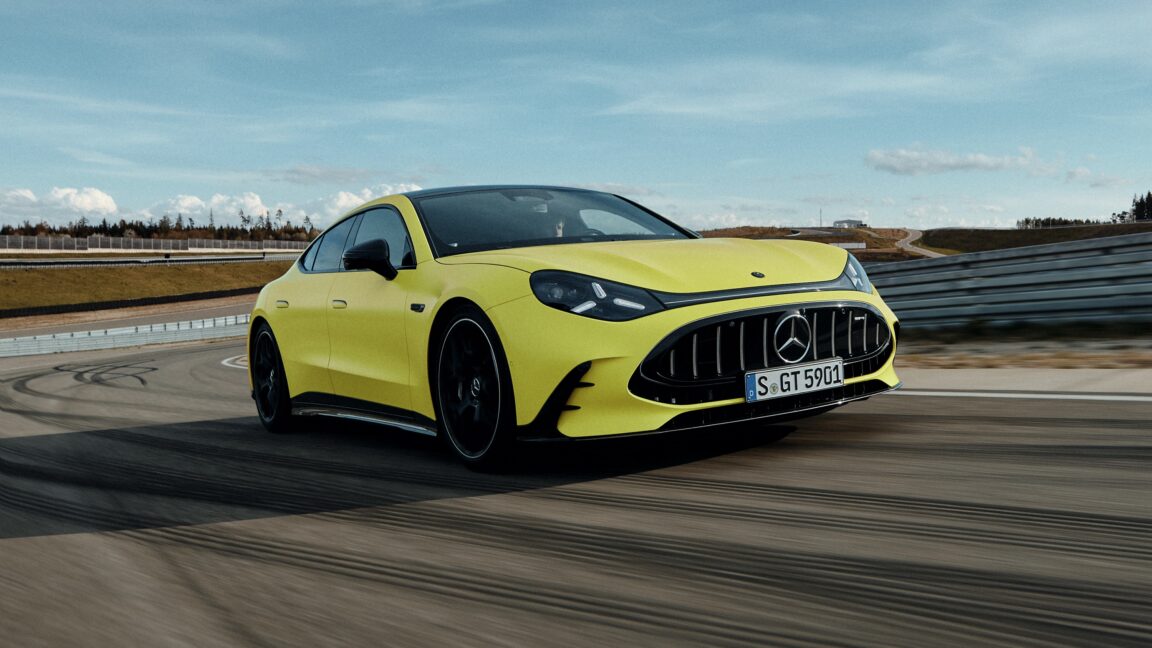
Leaving the V8 in the past: The all-electric Mercedes-AMG GT 4-Door
At a star-studded event that closed Downtown Los Angeles' Sixth Street Viaduct last night, Mercedes and AMG unveiled the next generation of performance electric vehicles.
The 0–60 time is impressive, the miles/kWh number even more so.
Fittingly, then, Mercedes brought out its F1 team’s personnel, as George Russell presented the new car while Toto Wolff and Kimi Antonelli watched from the makeshift grandstands. Hollywood celebs ran the gamut, from Brad Pitt—who drove one GT onto the bridge—to Jacob Elordi and Kevin Hart, while Blink 182 played a surprisingly sarcastic mini set. All of the above may mean less to potential GT buyers than performance metrics and pricing when the 2027 model year comes along, but it only serves to prove just how big a deal Mercedes-AMG believes this will be.
In person, the new GT bears almost no resemblance to any of Benz’s prior EVs. No more bulbous, nautical EQS shapes or minorly smoothed over boxy G-Wagen aesthetic . The new design is more aided by digital renderings and iterative algorithms, especially the jutting front grille, reclined headlights, and Kamm-tail rear end—a bit of Aston Martin fore and aft. From the profile view, the proportions fit somewhere between a Porsche Panamera or Taycan, low-slung and slippery for ideal aerodynamic efficiency.
Specs on paper support that impression, as the new GT measures 1.7 inches (43 mm) shorter in height and 1.4 inches (35.5 mm) longer overall, with the wheelbase stretched by 3.5 inches (89 mm) versus the outgoing model . Inside, the increasingly digital cockpit continues to evolve, with a new dash layout and canted touchscreens. The event afforded nobody but the stars a chance to actually sit in the passenger compartment, but diagrams shared with the media in advance revealed a typical EV skateboard chassis, albeit with a center spine similar to a transmission tunnel on an internal-combustion engine car to house critical EV components, as well as “foot garages” dropped in between battery modules that improve ergonomics. The large hatchback trunk behind the second-row seats complements a minuscule 1.4-cubic-foot (40L) frunk.
The four-door hatchback will launch in two variants, as usual a 55 and a 63. Both share the same hardware, though the former restricts output to “just” 805 hp (592 kW) and 1,328 lb-ft (1,800 Nm) of torque, while the latter bumps up to 1,153 hp (848 kW) and 1,475 lb-ft (2,000 Nm). All that shove comes courtesy of Mercedes-Benz’s wholly owned subsidiary, YASA, which last year announced a new world record for the most power-dense electric motor ever built. YASA’s axial e-motors can be found in McLarens , Lamborghinis , and Ferrari hybrids and in this application promise a 67 percent reduction in weight and physical length versus a more traditional radial-flux motor—with double the torque density and triple the power density, no less.