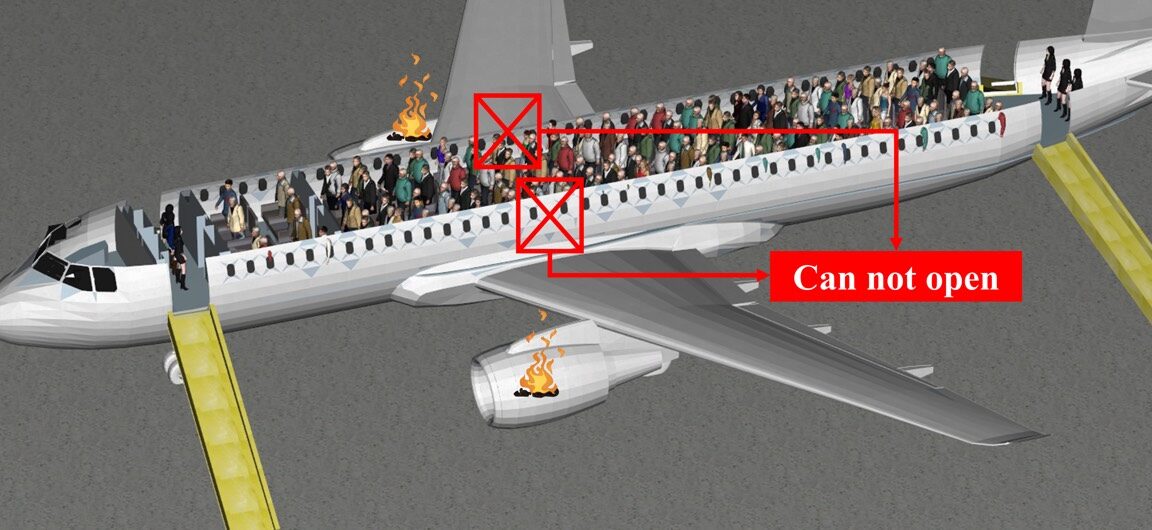
What's the best cabin layout for aircraft evacuation?
The Federal Aviation Administration (FAA) requires that, in the event of an emergency, all airplane passengers must be able to evacuate any aircraft within a 90-second window. But is that a realistic requirement, particularly given the increasing number of elderly passengers who might need more time and assistance? According to a new paper published in the journal AIP Advances, it is not. Various simulated scenarios showed evacuation times significantly higher than the 90-second requirement. This isn't the first time scientists have puzzled over this kind of optimization problem. Back in 2011 , Jason Steffen, now a physicist at the University of Nevada, Las Vegas, became intrigued by the question of the most efficient boarding method; he applied the same optimization routine used to solve the famous traveling salesman problem to airline boarding strategies. Steffen fully expected that boarding from the back to the front would be the most efficient strategy and was surprised when his results showed that strategy was actually the least efficient. The most efficient, aka the “Steffen method,” has the passengers board in a series of waves. Field tests bore out the results , showing that Steffen’s method was almost twice as fast as boarding back-to-front or rotating blocks of rows and 20–30 percent faster than random boarding. The key is parallelism: The ideal scenario is having more than one person sitting down at the same time. Read full article Comments
The key is to evenly distribute elderly passengers, who move more slowly, among the aircraft cabins.
And in 2020 , we reported on a study that found it is faster and more efficient to let slower passengers—the elderly or handicapped, people with small children—board first. The authors exploited the well-known connection between microscopic dynamics of interacting particles and macroscopic properties and applied it to the boarding process. In that case, the microscopic interacting particles were the passengers waiting in line to board, and the macroscopic property was how long it took all the passengers to settle into their assigned seats.
This latest study was partially inspired by the Emergency Vacating of Aircraft Cabin (EVAC) Act , introduced in December 2022 by US Congressman Steve Cohen (D-Tenn.), calling for updated evacuation regulations to take into account more realistic cabin conditions. According to the authors, prior research on aircraft passenger evacuation has examined various factors: the effect of different landing attitudes of Airbus A350-900 planes; increasing passenger obesity; passengers obstructing others by attempting to retrieve their luggage; and the impact of passenger fear, anxiety, and panic on optimal evacuation times, among other examples.