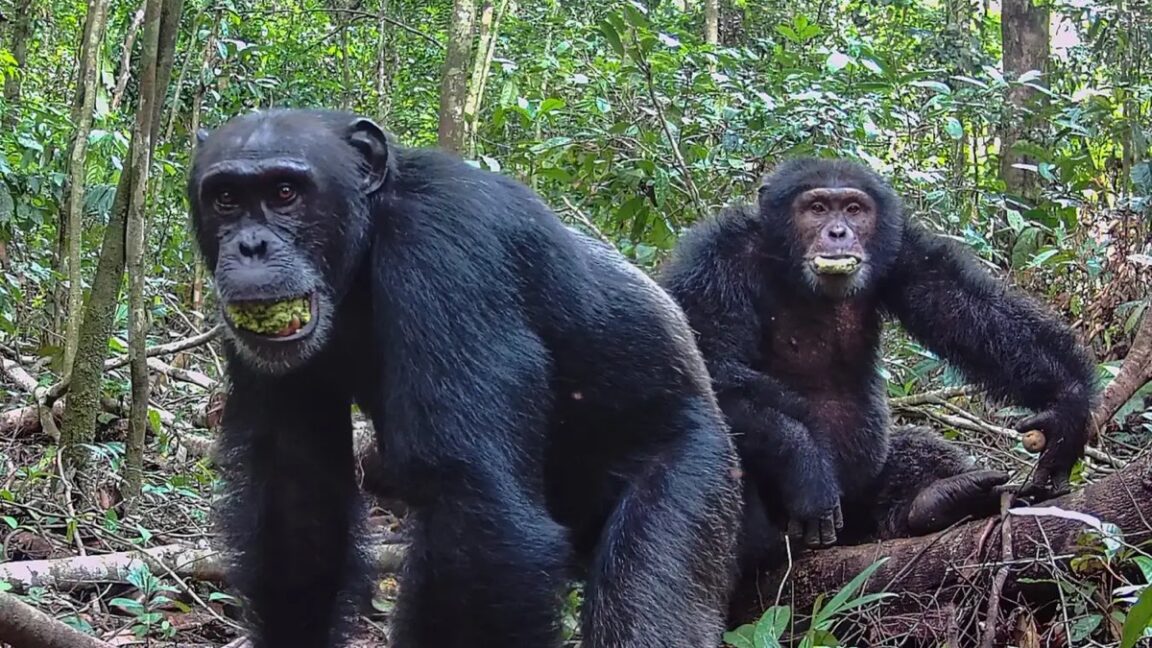
Ugandan chimps split into two factions, then killed rivals
In the 1970s, the late Jane Goodall observed a community of chimpanzees in Gombe, Tanzania, breaking into two factions; the males in one group ended up killing all the males in the rival group over the next four years...
Rare event suggests relational dynamics may play a role in collective violence, along with cultural markers.
“What’s especially striking is that the chimpanzees are killing former group members,” said co-author Aaron Sandel , an anthropologist at the University of Texas, Austin. “The new group identities are overriding cooperative relationships that had existed for years. I would caution against anyone calling this a civil war. But the polarization and collective violence that we have observed with these chimpanzees may give us insight into our own species.”
The authors analyzed 24 years’ worth of data from social networks, 10 years of GPS tracking, and 30 years of demographic data on the Ngogo chimps in Uganda’s Kibale National Park. They identified three distinct phases to the split. First there was an abrupt shift as chimp relationships became polarized into two distinct clusters: Western and Central. The chimps then spent the next two years increasingly avoiding those in their rival cluster; there were very few interactions across clusters, and Western male chimps started patrolling their territory, showing increased aggression toward Central males. By 2018, the fissure had become permanent.
Finally, the authors observed the outbreak of lethal violence resulting in the deaths of six adult males in 2018; the violence extended to the killing of 14 infant chimps in 2021. There were 14 additional chimp deaths between 2021 and 2024 that were not directly observed, and the authors suggest they may also have been killed since there had been no signs of illness in any of those animals. All the observed violent attacks were committed by the western group of chimps, despite being smaller in number. This contradicts the usual intergroup conflict models of power imbalance, in which larger groups are thought to have the advantage.
In a related perspective, James Brooks—a primatologist at the German Primate Center in Gottingen, Germany, who was not involved with the study—noted that 50 years ago, a community of wild bonobos split permanently into two groups without the same kind of intersectional violence; the groups coexist peacefully to this day. Various hypotheses have been proposed to explain this very different outcome, most notably the idea that there was a relative abundance of food in the bonobos’ environment. Sandal et al.’s findings challenge that hypothesis, however, since the chimps also seemed to have an abundance of food and yet were not able to peacefully coexist once they had split into two factions.