Physicists think they've resolved the proton size puzzle
There has been considerable debate among physicists over the last 15 years about conflicting measurements of the charge radius of a hydrogen atom's proton—some confirming the predictions of our strongest theoretical m...
“We believe this is the final nail in the coffin of the proton radius puzzle.”
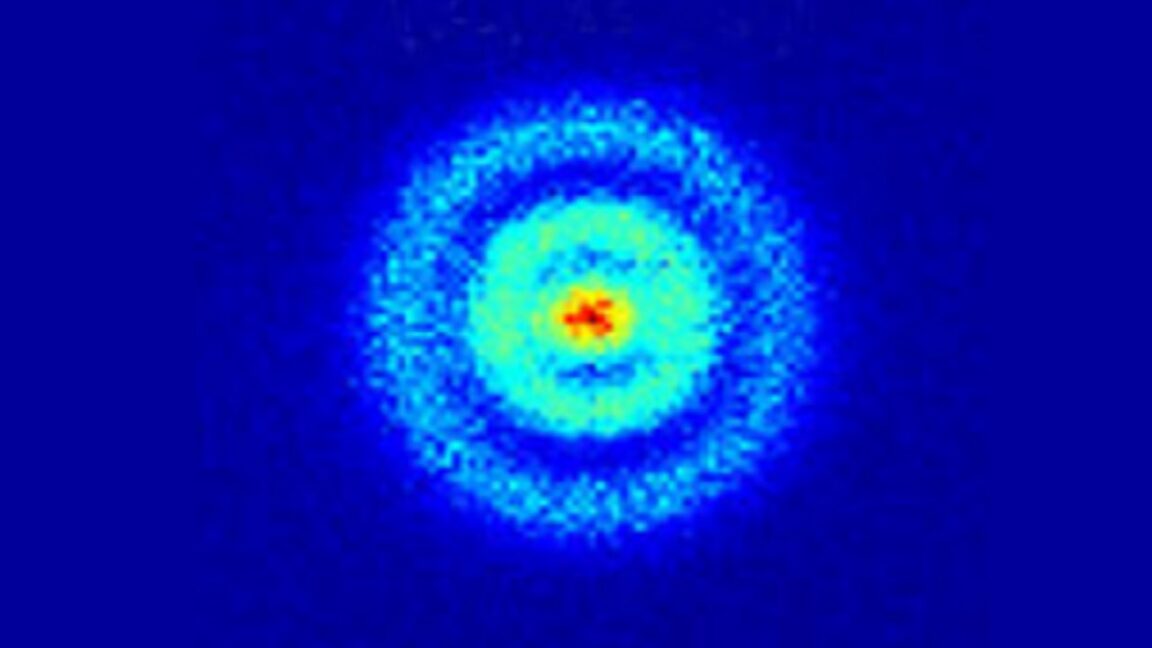
As previously reported , most popularizations discussing the structure of the atom rely on the much-maligned Bohr model , in which electrons move around the nucleus in circular orbits. But quantum mechanics gives us a much more precise (albeit weirder) description. The electrons aren’t really orbiting the nucleus; they are technically waves that take on particle-like properties when we do an experiment to determine their position. While orbiting an atom, they exist in a superposition of states, both particle and wave, with a wave function encompassing all the probabilities of its position at once. A measurement will collapse the wave function, giving us the electron’s position. Make a series of such measurements and plot the various positions that result, and it will yield something akin to a fuzzy orbit-like pattern.
Quantum weirdness extends to the proton, too. Technically, it’s made of three charged quarks bound together by the strong nuclear force. But it’s fuzzy, like a cloud. And how can we talk about the radius of a cloud ? Physicists rely on the charge density to do so, akin to the density of water molecules in a cloud. The radius of the proton is the distance at which the charge density drops below a certain energy threshold. And it’s possible to measure that radius by studying how the electron interacts with the proton, via either electron scattering experiments or by using electron or muon spectroscopy to look at the difference between atomic energy levels (the “Lamb shift”). The combined fuzziness of the electron and proton means that the electron can be anywhere inside that region—including inside the proton.
Hydrogen atoms are the simplest nuclei, with a single proton orbited by an electron, so that’s typically what physicists have used for their experiments to measure the proton’s charge radius. For a long time, the accepted value was .876 femtometers—a “world average” of many different measurements with sufficient error bars to allow for future measurements.